
Pillar and Post Socks Pattern.
- Katie Campling

- Jan 30
- 7 min read
Updated: Mar 11
This article contains affiliate links. If you make a purchase through one of these links I may earn a small commission. This helps my small business to continue running and providing free resources, thank you for your support.
In this post I have brought together a free toe-up sock pattern. I plan on sharing a beginner friendly vanilla sock with full tutorials on the techniques later on this year but I was keen to share a pattern for these simple socks as I enjoyed knitting them so much.
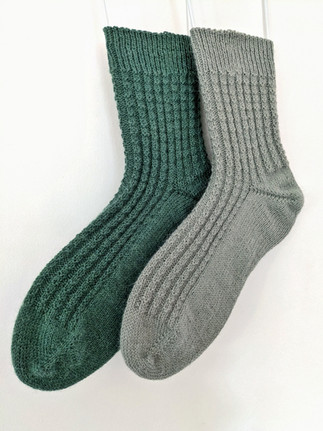
Late last year I knitted a few of these for family and they've all been gifted now so I won't be ruining any surprises by sharing the pattern! These socks use a stitch pattern commonly referred to as Pique Rib. This has a squashy and raised texture that feels warm and comforting but the stitch pattern is essentially 2x2 ribbing. You create the raised line of stitches by simply working all purl stitches on the fourth row.
I decided to call these socks Pillar and Post as the design creates a texture that looks a little architectural. I also had a hard time deciding the texture for these gifted socks and one was frogged three times! I feel like I went from 'pillar to post' before I settled on the Pique Rib.




Requirements -
Yarn | Drops Nord 4ply. 50g. 170m (186yrds). 45% Alpaca, 30% Polyamide and 25% Wool. |
Gauge | 30 stitches x 44 rows (10cm / 4in square) for stockinette worked on size 2.5mm (US 1.5) needles. |
Quantity | 2 x 50g balls of yarn. |
Needles | 2.5mm (US 1.5). Circular needles or DPNS depending on preference. |
Sizes | S (M, L) - Foot circumference 8 (9, 10) inches |
Extras | Stitch markers and a tapestry needle. Sock blockers are optional. |
Abbreviations -
K1 - knit the number of stitches indicated.
P1 - purl the number of stitches indicated.
M1 - make a new stitch using a yarn over. To prevent holes in your work, knit the yarn over through the back loop on the next round to twist it and close the eyelet.
Sample knits in the attached photographs are made using Drops Nord 4ply in colours - Goldenrod, Forest Green and Sage Green.
About the cast-on technique -
To cast-on a sock from the toe and work up, you'll need to use an invisible cast-on technique. I have linked to a technique called Judy's Magic Cast-on (JMCO) here this is in fact Judy Becker's original video explaining how to work her method.
I personally prefer to use the Turkish Cast-On method, which is similar to JMCO but instead you wrap the yarn around both needles together. The number of wraps will be half your starting stitches. You will need to use a circular needle to cast-on, but you can transfer to DPNS after.
The first step is to create a slip knot on one of your needles. Then, hold the two needles together - the slip knot should be on the bottom needle and the tips should point to the right.
Next, wrap the yarn around both needles tightly. Wrap the yarn as many times as the pattern requires, do not count your slip knot as a stitch.
After you've wrapped your yarn, pull the bottom needle through from left to right. This will pull the cable through the base of the loops, so that they are wrapped around a needle and cable together.
Next, you will knit into each wrap on the top needle. After you have worked all the stitches you will still have loops around the cable. Turn your work clockwise so you are ready to work the next side.
Switch your needles as follows - the top needle moves right to left picking up the loops on the cable, and the bottom needle is pulled left to right so it is free to become your working needle, saving the previous stitches on the cable.
Let your slip knot drop as it is no longer needed, but be careful not to lose the yarn end or your stitches will unravel. They aren't secure until all loops are knitted.
From here you will knit into each loop on the needle as before. You now have a firm foundation to work on and each loop has become a stitch. You will need to keep working in the round, increasing at each edge to create your toe shaping.





Knitting the toe -
Using a 2.5mm (US 1.5) circular needle and an invisible cast-on technique, make -
24 (28, 32) stitches from 12 (14, 16) wraps/loops.
From here, you can continue on 2.5mm (US 1.5) circular needles using a magic loop method. Or, you can switch to 2.5mm (US 1.5) DPNS and spread the stitches evenly across 4 needles, leaving one working needle.
The first half of your stitches - 12 (14, 16) - are for the top of your foot, referred to as the instep and the second half will be the bottom of the foot, or the sole. You can use stitch markers to help you keep the instep and sole of the foot separate as you work.
Round 1 - Work the following instructions twice for each round. Once for the half of your stitches that form the instep and once for the half that will form the sole -
K1, M1, knit to last stitch, M1, K1
You have now increased your work by 4 stitches - 28 (32, 36)
TIP: Use the technique suggested in the abbreviations section for M1. When you work the yarn over from the previous round, knit through the back of the loop to prevent holes on the sides of the toe.
Round 2 - Knit all stitches in the round.
For each size, you will need to work these two rounds -
9 (11, 12) times, for a total of 56 (64, 72) stitches.
End with round 2.
Knitting the foot -

When knitting toe-up socks with texture, I usually try to arrange the pattern repeat so that the first and last stitch is a purl. I do this so the top stitches for the foot don't blend into the bottom sole stitches. As you can see in the picture opposite, the pattern is seamless when you reach the leg and start working the repeat on all stitches. This arrangement isn't noticeable after the heel but does make a difference to the finished look of the foot.
Below is a chart for the pattern repeat, which should be read from right to left only as you're working in the round. After the chart you'll also find written instructions -

Round 1 - P1 * K2, P2 * repeat to last stitch for the instep, P1, knit all stitches for the sole.
Round 2 - as round 1
Round 3 - as round 1
Round 4 - purl all stitches on the instep, knit all stitches on the sole.
Repeat rounds 1 - 4 until you reach the desired length for the foot before the heel. You can use your own foot measurements, or use the size suggestions below -
S - 6.5 inches
M - 7 inches
L - 8.5 inches
Turning the heel -
I love to work a german short row heel when I make toe-up socks. If you are familiar with a german short row heel, you'll know that you need to work a double stitch at each edge as you work shorter and shorter rows towards the turn.
For each size you will need to work these rows until you have -
S - 9 double stitches on each edge, and 10 normal stitches in the center
M - 10 double stitches on each edge, and 12 normal stitches in the center
L - 12 double stitches on each edge, and 12 normal stitches in the center
Below are some instructions for starting to work a heel turn with this method -
Work along the stitches for the sole until you reach the last stitch. Leave this stitch behind and turn your work. You are now working rows instead of rounds.
Create a double stitch purlwise, then purl to the last stitch. Leave this stitch behind and turn your work again.
Create a double stitch knitwise, then knit until you reach the double stitch on the opposite side. Do not work the double stitch, instead turn your work.
After you have set up your rows as described above, you'll knit back and forth in rows. With each row you'll create a double stitch and leave a stitch behind. Your rows will get shorter until you have the desired number of double and central stitches.
You'll turn your heel by first placing a stitch marker at each end of your central stitches. Then knit two rows where you work all the double stitches on both edges, you should end with right side facing you. Then start to work the second half of the heel -
Knit to the second stitch marker on your needle. Remove the stitch marker, and complete one additional stitch after.
Turn your work and create a double stitch purlwise. Then purl until you reach the next stitch marker. Remove the stitch marker and purl one additional stitch after.
Turn your work and create a double stitch knitwise. Then knit until you reach the double stitch on the opposite side.
Knit your double stitch and one more stitch after.
Turn your work and create a double stitch purlwise. Then purl until you reach the double stitch on the opposite side.
Purl your double stitch and one more after.
Keep working back and forth along the rows moving the double stitch by one on each row until you've picked up all your stitches again. When you reach the last stitch, you can then start to work in the round for the leg.
Knitting the leg and cuff -
After you have worked the heel you will start to work in the round again, including the stitches previously left behind on your cable or DPNs. Working the leg you will follow the same pattern repeat as the foot but across all stitches.
Round 1 - P1 * K2, P2 * repeat to last stitch, P1.
Round 2 - as round 1
Round 3 - as round 1
Round 4 - purl all in the round.
Continue in this pattern for the desired length of the leg before the cuff. Then, the cuff is worked as 1x1 ribbing - * K1, P1 * repeat until the end.
As a guide, I usually work approximately 7 inches of leg and 2 inches of cuff but you can work until you are happy with the length or until your yarn runs out!
Cast-off the sock using a stretchy method such as Jenny's Surprisingly Stretchy Bind-off, or the Italian Bind-off which is sewn.
The examples in the pictures use the Italian Bind-off.
Well done for knitting up your Pillar and Post socks and I hope that they are now keeping yours, or a loved ones, feet warm. This is one of my first sock patterns and the first that I've written for the blog, if you have any feedback I'd love to read it down in the comments.
Happy knitting!
Katie


Comments